
Current Research
Projects
Topic modelling for hypothesis-driven communication analysis
Introduction
In forensic analyses of instant messages from seized mobile devices, identifying case-relevant communication is a central challenge. Relevant content typically represents only a small fraction of the available data and is obscured by everyday conversations. What counts as relevant depends on the investigators’ forensic hypotheses (e.g., whether certain offenses have been committed). Investigators, therefore, need reliable methods to efficiently determine whether any hypothesis-related, case-relevant topics have been discussed.
Objectives
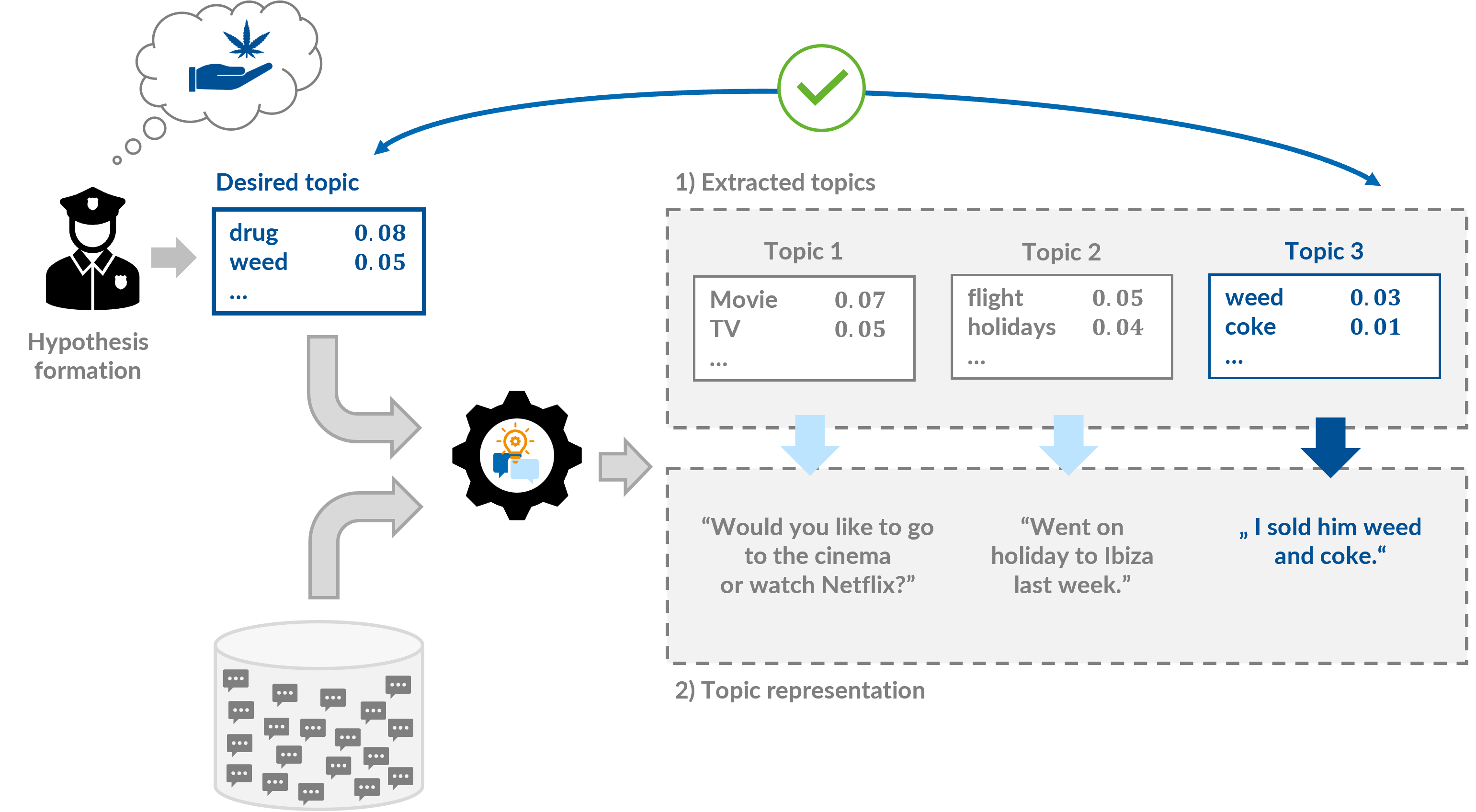
This doctoral research addresses this need by developing a method to present such topics in a concise, interpretable way. However, traditional approaches to topic modelling are associated with two problems: first, they tend to overlook rare topics relevant to the case. Secondly, traditional topic representation as a probability distribution over words is difficult to interpret. To counteract this problem, a two-stage approach is being developed, which is shown in the figure below using the example of the hypothesis that a drug crime has been committed.
Case-specific knowledge related to the hypothesis is integrated into the topic modelling process to encourage the extraction of rare, relevant topics. This case-specific knowledge is formulated as a desired topic.
Topic interpretability is improved by introducing an alternative topic representation in which characteristic short texts, such as representative instant messages, serve as topic descriptions.
Subsequently, the investigator can assess whether any of the extracted topics correspond to the expected case-relevant topic. If so, as demonstrated in the example, this may constitute evidence in support of the hypothesis.
A significant challenge in developing this approach is the lack of publicly available forensic data sets. To overcome this issue, realistic synthetic data is currently being generated using large language models (LLMs). During this generation process, specific challenges are addressed, including the faithful reflection of typical communication behaviour, the characteristic linguistic style of instant messages, and the fact that relevant content is often expressed implicitly. The ethical implications of LLMs in both science and everyday life, particularly in light of EU AI Act, are being investigated in companion studies by the research group.
Publications
- Felser, J., Labudde, D., & Spranger, M. (2023). Towards Hypothesis-driven Forensic Text Exploration System. Proceedings of the 2023 IARIA Annual Congress on Frontiers in Science, Technology, Services, and Applications, 42–47.
- Felser, J., & Spranger, M. (2024). Semi-supervised topic modelling as a tool for hypothesis-driven forensic communication analysis. Proceedings of the 4. International Workshop on Digital Forensics (IWDF4). https://doi.org/10.18420/INF2024_22
- Felser, J., & Spranger, M. (2025a). Die (Un)gerechten: Ein kritischer Beitrag zu ethischen Risiken von Large Language Models: Annual Perspectives on Next Generation Science. NextGen Scientific Review – Annual Perspectives on Next Generation Science, 3, 76–82. https://doi.org/10.48446/OPUS-15908
- Felser, J., & Spranger, M. (2025b). Towards Interpretable Topic Modelling as a Tool for Hypothesis-Driven Forensic Communication Analysis. Proceedings of the Digital Forensics Doctoral Symposium, 1–8. https://doi.org/10.1145/3712716.3712721