
Current Research
Projects
Semantic analysis of digital text based communication data for personality modeling for digital forensic appliances
Investigative authorities face immense challenges when reviewing and analysing digital evidence. Individual phones that are part of criminal proceedings can contain hundreds of thousands of messages across multiple channels and conversation partners. Law enforcement agencies need powerful analysis tools and procedures to structure the data. The MoNA analysis software already covers many use cases, enabling a systematic and, above all, accelerated approach to work.
However, if conservative methods fail and no relevant communication participants or communication fragments can be identified using machine-assisted methods, law enforcement agencies are forced to rely on manual viewing and analysis methods. Due to the immense amounts of data involved, this scales with the costs that must be incurred to complete the investigation.
At this point, efficient filter mechanisms that assist in the screening process are essential. In the course of operational case analysis (OCA), the creation of a perpetrator profile is an integral part of the methodology. When an OCA creates a personality profile of the perpetrator, the question arises as to whether the personality can be converted into a filter criterion. If, for example, the OFA provides a personality profile, corresponding patterns may be present in the communication data in order to prioritise certain participants in the analysis.
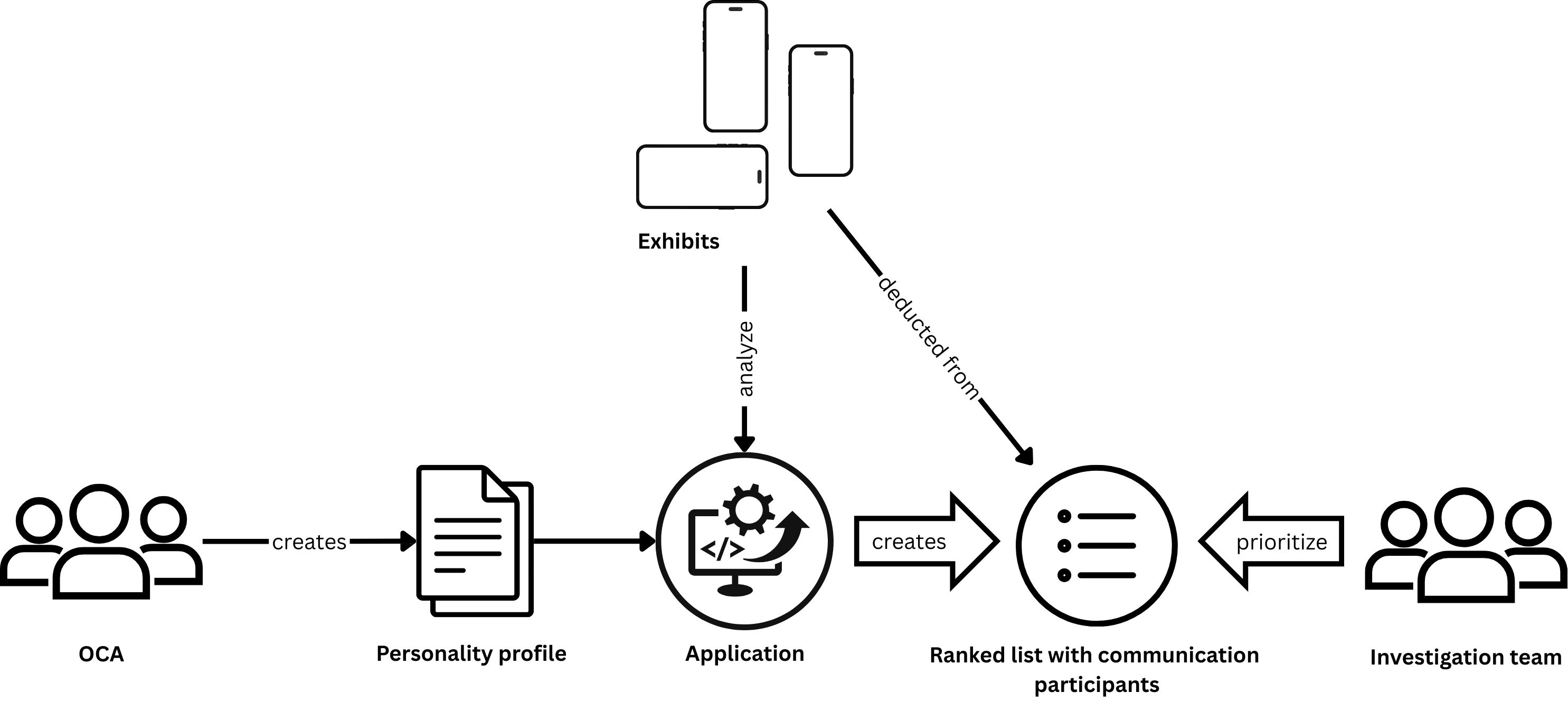
As part of this doctoral research, we investigate whether and how personality traits or personality dimensions are expressed in text-based communication. A key problem here is the acquisition of data for the development of intelligent algorithms. Even without any reference to IT, a person’s personality is a very complex asset that has been studied by social scientists for centuries. An interdisciplinary approach that bridges the gap between computer science, machine learning, modern AI methods and social sciences therefore seems indispensable for finding a solution. In addition, comprehensive evaluation strategies and collaboration with experts from forensic psychiatry, state criminal investigation offices and, last but not least, the social sciences are necessary. In order to realise this complex project, the methodological basis must first be rethought.
Previous approaches to personality extraction from text have primarily focused on linguistic features such as word choice, mood, sentence length, or spelling. our approach, on the other hand, pursues a fundamentally different strategy based on the assessment methods used in established personality tests: instead of analysing how someone writes, we examine what communicative behaviour reveals about their response tendencies to personality inventory items.
The central methodological innovation consists of the systematic combination of quantitative questionnaire items with authentic text-based communication. Established personality tests such as the Big Five Personality Inventory are based on self-report questionnaires with fixed response scales (e.g., from ‘strongly disagree’ to ‘strongly agree’). However, these response tendencies can also be assessed by third parties, such as spouses or close friends. If close friends can draw conclusions about personality traits based on observed behaviour, it should also be possible to find behavioural patterns in digital communication that enable such conclusions to be drawn.
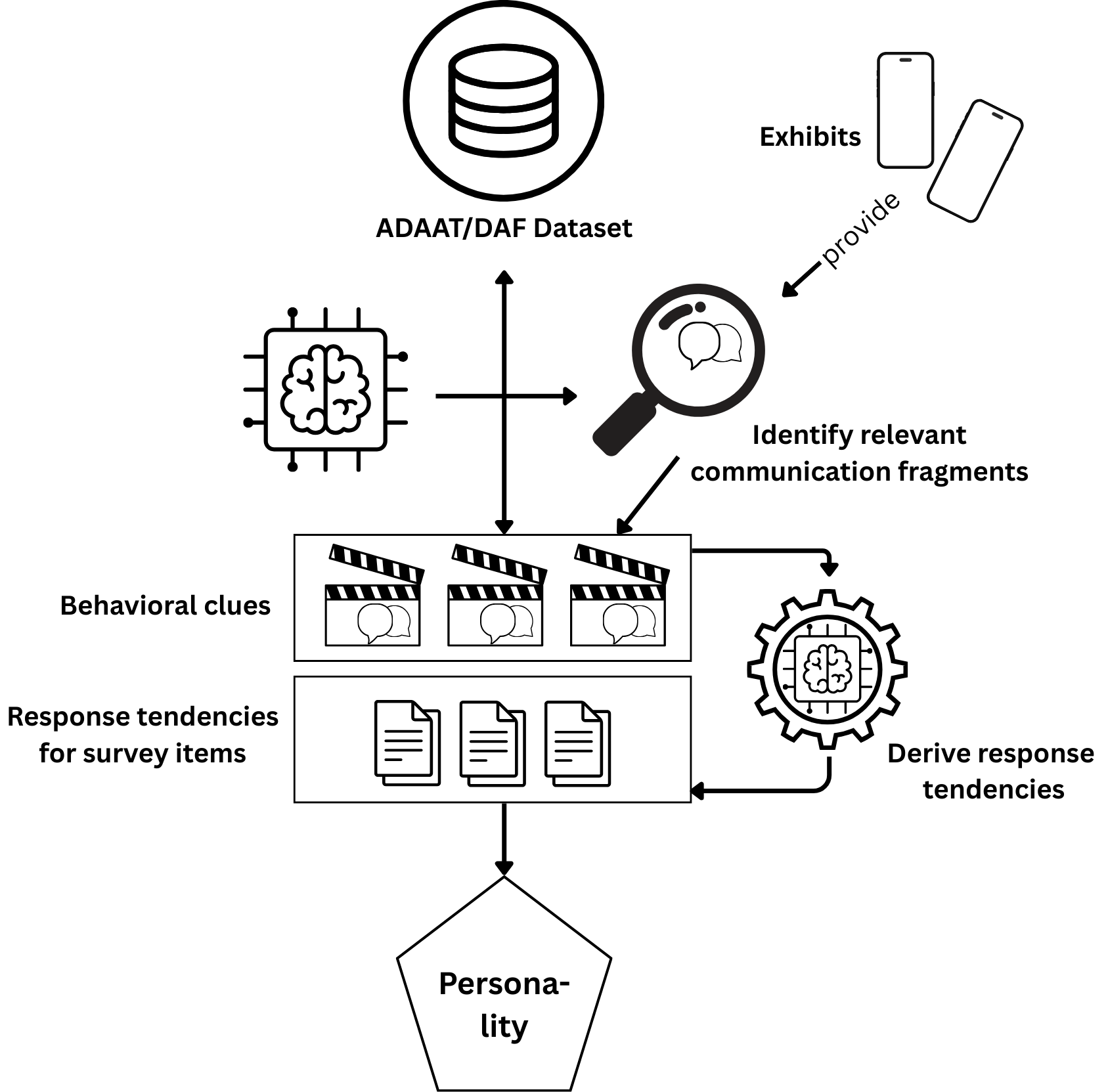
Another step in the doctoral project involves identifying communication fragments from which response tendencies can be derived. The aim is to develop an algorithm that analyses communication to infer response tendencies for inventory questions, thereby enabling a behaviour-based personality assessment.
The current state of the research addresses the dataset problem and thus involves the development of a framework and data aquisition tool (see ADAAT/DAF).